Your Best Ride This Year Probably Didn't Have Your Best Numbers
Dave · June 16, 2026
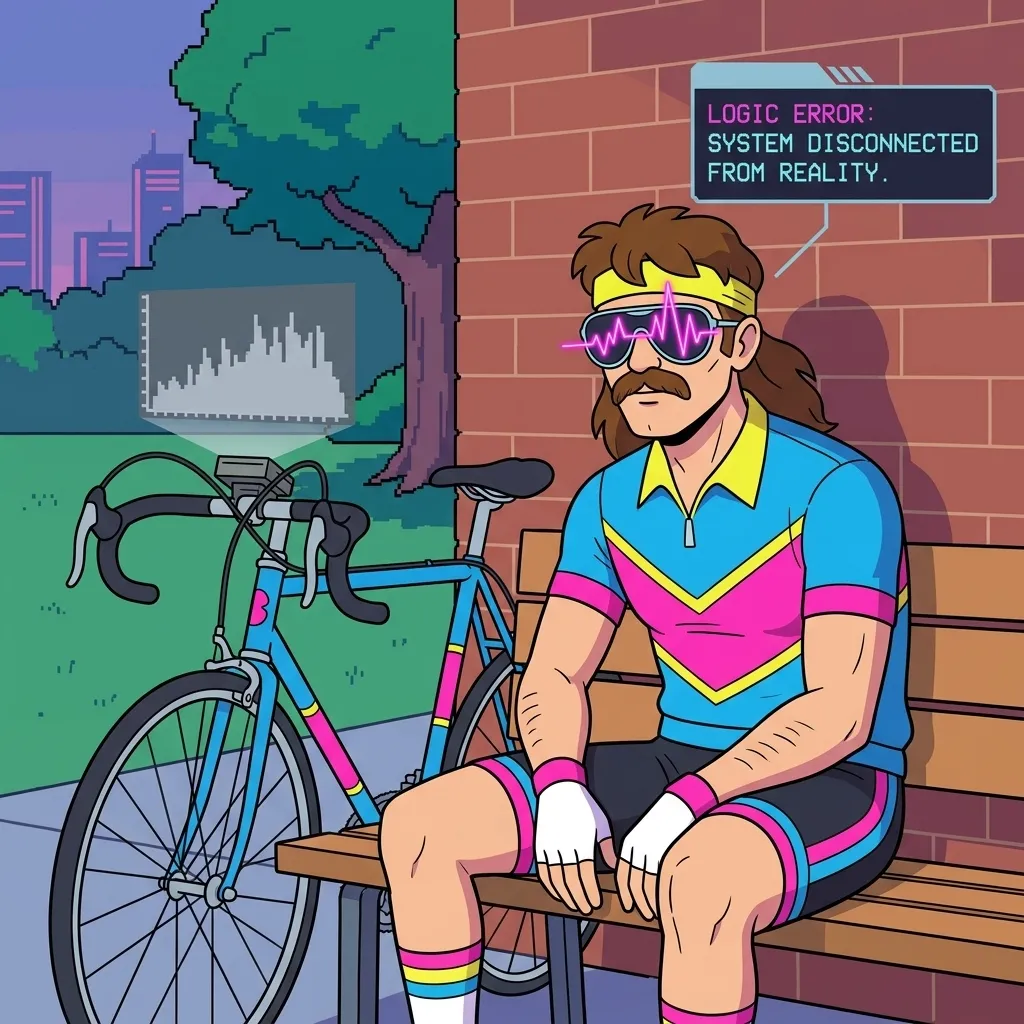
Think back to your best ride this year. The one you’re still talking about. Now tell me your normalized power from that day. Your average heart rate. Your training stress score. I’d bet good money those numbers were middling at best. Maybe even a little embarrassing on paper. And that’s exactly the point.
There’s a ride in all of us — happened to me on a Thursday in 1987, somewhere in the Pyrenees, no power meter, no plan — where everything just worked. Legs turned over like they were greased. Breathing was easy. Time disappeared. You weren’t chasing a number. You were just riding. And those rides, the ones that feel frictionless and alive, are telling you something important about where your fitness actually is. The data usually catches up later.
Why Your Best Days Don’t Always Show Up in the Numbers
This happens more than people admit. You go out on what should be a junk day. Maybe your HRV was flat that morning. Maybe you slept six hours. Maybe your last hard session was only 48 hours ago. And then you turn the pedals and something clicks. You hold a pace that would’ve hurt two months ago, but today it feels conversational.
That’s not luck. That’s adaptation landing.
The problem is your training software doesn’t celebrate that. It sees a moderate-power, moderate-heart-rate ride and files it under “recovery.” But your body just demonstrated something remarkable. It handled the load so efficiently that it didn’t look like load. That’s the whole goal. That’s what years of consistent work is supposed to feel like.
What “Best Cycling Performance Feel vs Data” Is Actually Measuring
Here’s what I know from years of riding and watching riders: perceived effort is not soft information. It is information. Precise, real-time, integrating everything your nervous system knows about fatigue, readiness, and capacity. Your legs know more than your head does most of the time.
When cyclists talk about best cycling performance feel vs data, they usually mean a ride where the power looks underwhelming but the sensations were exceptional. Low perceived effort for a given pace. Smooth high cadence without trying. Climbs that felt like rollers. That combination is a physiological signature. It means your aerobic engine is firing cleanly and your muscles are recovering fast enough to keep up with demand.
I’ve seen riders hit new FTP tests two weeks after a ride exactly like that. The feel came first. The watts confirmed it later.
Why Did My Ride Feel Good With Low Power? Here’s the Real Answer
This is one of the most common questions I get. Why did my ride feel good with low power? Usually it’s one of three things.
First, cumulative fatigue has finally cleared. You’ve been building for weeks, maybe months. The load was suppressing your output without you realizing it. Then you taper slightly, or sleep actually happens, and suddenly the ceiling lifts. Power looks normal but everything underneath is humming.
Second, environmental conditions masked the effort. A tailwind. Mild temps. Low humidity. Your body wasn’t fighting the world. It was just riding. Numbers look modest. The experience was not.
Third, and this is the one I love most: you were in flow. Genuinely. Psychologically tuned in, not thinking about the ride, just riding. Research backs this up. When cognitive load drops, perceived effort drops with it. You’re not working less. You’re spending less energy on the experience of working. That’s a skill, by the way. It’s trainable.
Heart Rate Coherence and Sleep Tell You More Than One Hard Number
Your average power on a given day is a snapshot. What it doesn’t capture is the quality of the physiological state underneath it. That’s where heart rate coherence comes in.
On your best days, your heart rate doesn’t just sit at a number. It responds fluidly to effort and eases back quickly when you back off. The line between effort and recovery gets shorter. That’s cardiovascular efficiency in real time. You’ll rarely find a software metric that flags this as a win, but your body is absolutely registering it.
Sleep is the other invisible variable. One night of poor sleep tanks perceived effort accuracy. Two nights and your power output drops measurably. But then you get three good nights in a row, and something shifts. The ride that follows often doesn’t look like a breakthrough. It feels like one.
I used to think rest was the absence of training. Now I know it’s where the training actually happens. The ride that felt effortless this year? Trace it back 72 hours. I’d guess you slept well.
How to Use Subjective Ride Quality as a Training Signal
Start logging how rides feel, not just what they produce. One number. One to ten. How hard did that actually feel relative to how hard it looked on paper? Do this consistently for eight weeks and you’ll start to see a pattern.
When perceived effort drops below what the data predicts, that’s a green flag. You’re ahead of where your metrics think you are. That’s the moment to consider a quality session, not a junk one. Don’t waste the window because your training plan says it’s a recovery day.
When perceived effort is higher than the numbers justify, that’s your body asking for something. Sleep, food, time. Respect it.
The riders I’ve worked with who break through aren’t always the ones who train the hardest. They’re the ones who got good at reading the difference between hard that’s productive and hard that’s just hard. Perceived effort cycling is the first language your body speaks. The numbers are the translation.
Your best ride this year wasn’t a fluke. It wasn’t a gift. It was your fitness showing up without the noise. Pay attention to the days that feel like that. Write them down. Figure out what the 48 hours before them had in common. Then stop waiting for the data to tell you you’re ready. Your legs already know.