The Ride That Changed How I Think About Suffering
Dave · July 1, 2026
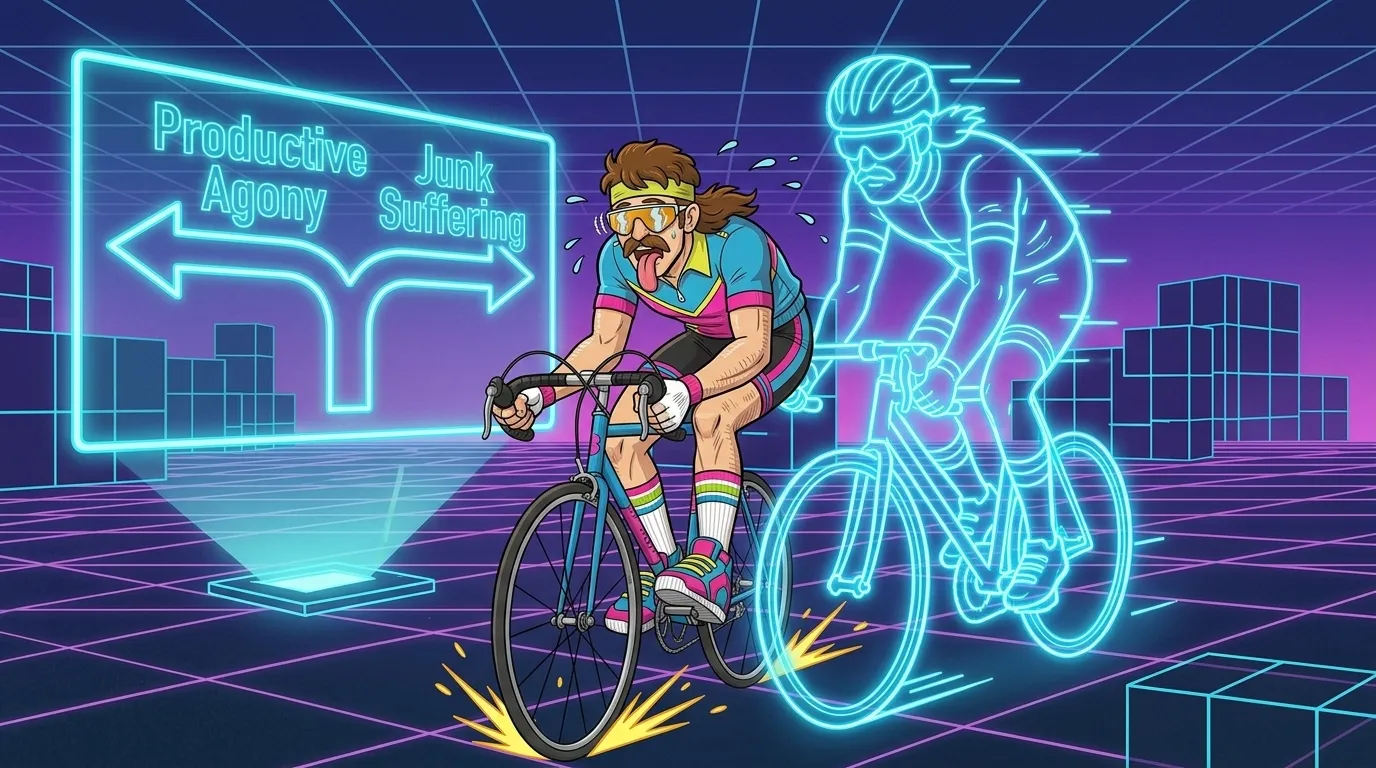
There’s a climb I still think about. Col de la Madone, 1991, halfway up, quads screaming, vision narrowing to a tunnel. I had a choice. Not the choice you think — it wasn’t quit or keep going. It was: what kind of pain is this? That question changed everything. Suffering in cycling isn’t the enemy. Junk suffering is. And most riders can’t tell the difference, which means they’re either quitting too early or grinding themselves into dust for no reason. Here’s how I learned to tell them apart.
What Productive Suffering Actually Feels Like
It burns. Obviously. But there’s a quality to it — almost a conversation. Your legs are talking to you, not just screaming at you. On a hard climb, when you’re at threshold, the discomfort has information in it. It tells you where your edge is. It shifts when you adjust your cadence. It responds.
I’ve had riders describe it as “a fire you can steer.” That’s exactly right. Productive suffering has agency inside it. You’re not being dragged along by pain — you’re negotiating with it. The watts hold. The cadence stays honest. Your breathing is hard but it’s rhythmic.
That’s cycling mental toughness working in real time. Not gritting your teeth and going numb. Actually listening, adjusting, staying in dialogue with your body.
What Junk Suffering Looks Like From the Saddle
Junk suffering feels like a wall. No conversation. Just static. You’re deep in the red on the wrong kind of day — maybe you slept four hours, maybe you’ve been riding on empty calories for three hours, maybe you hit the first climb too hot because someone’s Strava segment got your ego involved. The pain isn’t productive. It’s just damage.
I’ve done junk suffering. Plenty of it. Back in the VHS days, I filmed a segment where I was genuinely running a fever and refused to call the shoot. I “pushed through” a four-hour ride. Looked tough on camera. Felt like garbage for ten days afterward. My power didn’t bounce back for weeks.
The data backs this up, and the data is brutal in its honesty: power output during genuine junk suffering drops and stays dropped. Heart rate decouples — climbs while watts crater. Your body is not adapting. It’s just eroding. There’s no fitness being built. Just debt accumulating.
How to Know Which Kind You’re In
This is where it gets practical. Two questions. Ask them mid-ride.
First: is my form still functional? Hips rocking, shoulders hunched up into your ears, jaw clenched so hard you’d crack a molar — that’s not grit, that’s collapse. If your mechanics are falling apart, the work quality is gone.
Second: did I arrive here on purpose? There’s a massive difference between choosing to hurt at the end of a structured interval and ending up destroyed because the ride went sideways. Planned hard is almost always productive. Accidental redline is almost always junk.
When I coach riders on how to push through hard rides, I don’t teach them to ignore the signals. I teach them to read them faster. The riders who develop real toughness are the ones who know, within about thirty seconds, whether they’re in a productive hurt or a dumb one. That discernment is a skill. You can train it the same way you train your VO2.
The Suffering Cycling Philosophy Nobody Talks About
Here’s the part that sounds soft until you’ve ridden 200 kilometers into a headwind and had to make decisions. Suffering only makes you better when you meet it with presence.
That sounds like a bumper sticker. Stick with me.
When you dissociate to get through pain — go to your happy place, count down from a hundred, put your brain somewhere else — you’re surviving. That has its moments. I’m not saying never do it. But you’re not learning anything. You’re not building the mental calibration that makes hard rides easier over time.
The riders I’ve seen develop real cycling mental toughness are the ones who stay in it. Eyes open. Aware of what’s happening in their body. Curious about it, almost. Like they’re gathering data rather than enduring punishment. Phil Liggett used to say the great climbers looked like they were suffering differently than everyone else. He was right, and now I know why. They were engaged with it. The rest were just victims of it.
Suffering cycling philosophy, stripped to the bone: pain is information. You can ignore it, fight it, or learn its language. The third option is what separates the riders who plateau from the ones who keep finding new gears five years in.
What the Data Shows vs. What You Should Feel
Power meters are miraculous. I coach with them, I trust them, I believe in the numbers. But here’s what the numbers can’t tell you: whether the suffering you’re in right now is worth it.
A rider hits a 6.5% gradient, power drops from 280 watts to 240, heart rate is at 172. The numbers say: struggling, not at target. But I need to know what the rider feels. Is that 240 watts a wall, or is it a floor they can build from? Is the 172 BPM spiking or is it stabilizing?
The data shows what’s happening. Your awareness tells you what it means.
I’ve seen riders bail on sessions their body was actually ready to finish. The numbers looked bad, and they trusted the numbers over themselves. I’ve also seen riders torch their training block because they were so proud of yesterday’s power file they refused to call today done. Both failures come from the same place: not knowing how to interpret what you’re feeling.
The best rides I’ve ever coached, and the best rides I’ve ever done, happen when the numbers and the sensations are in agreement. When you know you’re hurting and you know it’s the right kind of hurt and you know why.
That climb in 1991? I made it to the top. Not because I ignored the pain. Because I stayed in the conversation long enough to realize my body had more to say. Most of the time, it does. The job is learning to listen without flinching.