Your Heart Rate Climbed. Your Power Didn't. Here's What Happened.
Dave · October 14, 2026
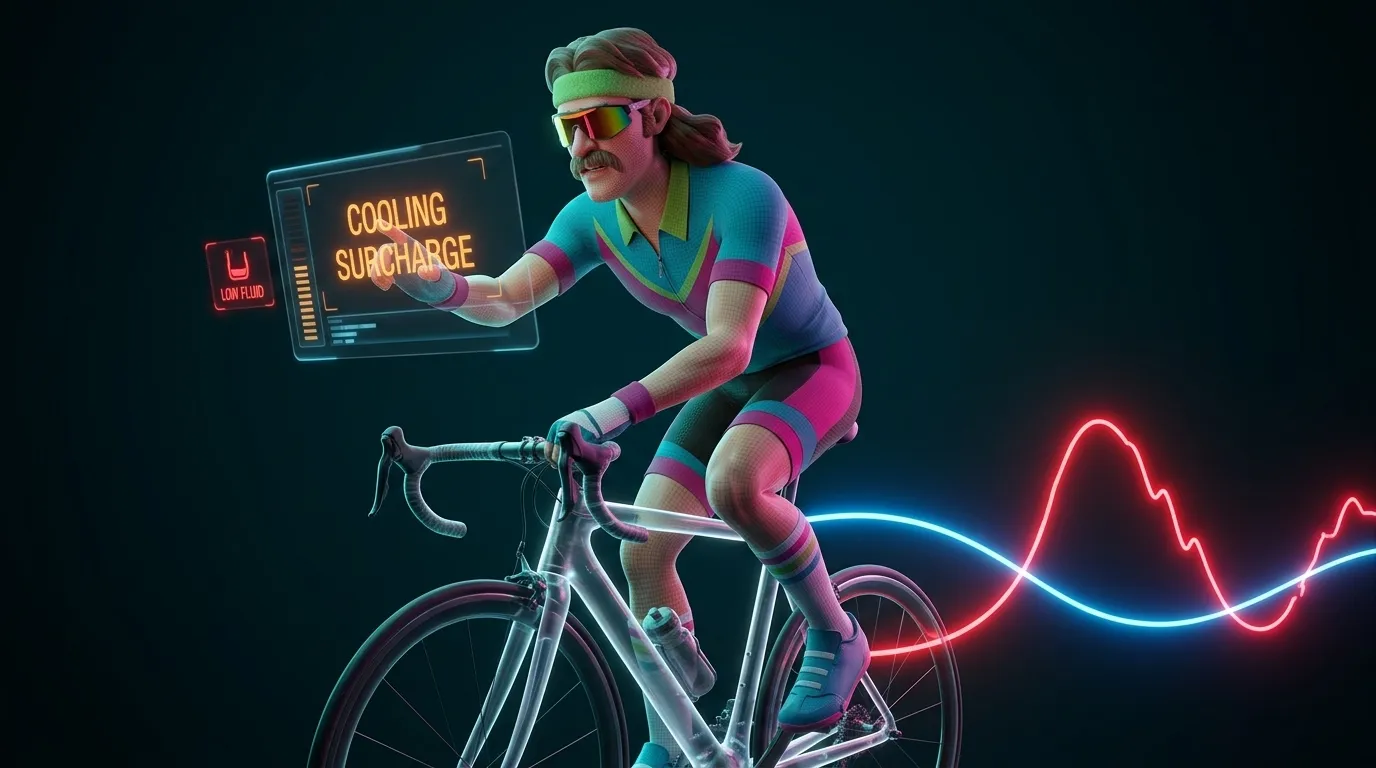
When your heart rate keeps climbing while your watts sit still, you’re looking at cardiac drift. Your body is paying more to hold the same output, and most of the time that’s because you’re hotter and a little drier than when you rolled out. Drift is not a verdict on your fitness. It’s a receipt for what the day charged you, and on a summer afternoon heat is usually holding the pen.
Why does my heart rate go up when my power stays the same
Picture a steady ride on a flat river road. You hold 200 watts the whole way. In the first hour your heart rate sits around 138. By the back half of the second hour it’s 151, and you haven’t touched the pace. Same road, same watts, thirteen extra beats.
Every minute you sweat, a bit of water leaves your blood. Less blood means less comes back to the heart on each beat, so each beat pushes out a little less. To keep moving the same amount of blood, your heart beats faster. Your skin is also asking for blood so it can dump heat, and your legs want it to keep turning the cranks. Your heart is serving both of them at once, and the only way it can do that is to speed up.
None of this means you got weaker between mile 10 and mile 40. That’s why I treat power as the primary read on effort and heart rate as the second opinion. Power tells me what you did. Heart rate tells me what it cost on that particular day.
I learned this before I had words for it. We shot a sprint sequence for Pedal to the Medal in a parking lot outside Bakersfield in July, and the director wanted take after take. By the afternoon my legs were fine, but my pulse was going through the roof on efforts that had felt easy at nine in the morning. The mustache wilted too. Nobody wrote that into the script.
Cardiac drift cycling: why the second hour costs more
The first hour has a small budget. You start with full blood volume, cool skin and plenty of stored carbohydrate. The second hour inherits whatever the first one spent. Fluid losses pile up, your core temperature creeps higher, your carbohydrate stores run lower, and the muscle fibers that did the early work start tiring, so your body brings in bigger, thirstier ones to hold the same watts. Cadence often slips a few rpm without you noticing. All of that shows up in one place: a heart rate that won’t stay where you left it.
Sometimes it runs the other direction, and that confuses people. One rider asked me why their heart rate was higher early but the effort felt easy by the end, and whether that meant they’d stopped working hard. If the watts held, they didn’t stop working. Early heart rate often runs high from nerves, a cold start or that first climb before your system settles. Later in the ride, a lower number at the same power means things calmed down. It doesn’t mean you were coasting.
Heart rate higher than usual at the same effort: heat or fatigue?
This is the question that matters, because the two call for different responses.
Heat drift has a personality. It shows up on hot days and gets worse as the temperature rises. Your watts hold. Your legs feel mostly fine, even when the number on the screen looks alarming. It fades fast once you stop and cool down, and the next morning you’re ready to go again.
Fatigue drift is a heavier thing. It turns up on cool mornings too. The watts sag, or holding them takes more effort than it did last week. Your legs feel wooden in the warm-up, recovery between intervals drags, and the pattern repeats ride after ride when the weather can’t take the blame. I’ve called cardiac decoupling a sign of junk suffering before, and I stand by that when it comes with crashing watts and slow recovery. On its own, on a 90-degree afternoon, it’s mostly weather.
Another rider bailed on a ride because their heart rate wouldn’t come down and blamed the heat first, with fatigue and some pain as maybes. Putting heat first was the right call. Pain is the one I’d never wave off, though. If something hurts in a way that doesn’t feel like work, that outranks every number in the file.
I’ll name my own blind spot here. I see the temperature when your head unit records it, but I can’t see how much you drank or how much you sweated out. So I’m reading the hydration half of drift from the edges, and I don’t love that. I’d like a cleaner read on it than an educated guess.
What to do when your heart rate drifts on a long ride
First, compare like with like. Take the first half and the second half of a steady ride and check your heart rate at matching power. The well-established rule of thumb says that on a long, steady endurance ride, drift under about five percent means your aerobic engine is holding up nicely. In real heat, expect more and don’t panic about it.
Second, decide whether to chase the number or the watts. If the ride was about holding power, let your heart rate do what it needs to do. If it was meant to stay genuinely easy and aerobic, back the watts off as your heart rate climbs. Which one is right depends on what the ride was for, and that’s exactly why I ask for intent before the deep read.
Third, run the experiment. Ride the same loop on a cool morning, drinking from the first fifteen minutes and not waiting until you’re thirsty. If the drift mostly disappears, it was the weather. If it shows up again in cool air with good fueling, and keeps showing up, that’s your body asking for an easier week, and we should talk about what the last few weeks have actually taken out of you.
Then tell me how it felt. I can see the heart rate. I can’t see whether your legs felt like springs or sandbags, or whether you’d been up half the night with a sick kid.
Your heart wasn’t failing you out there. It was doing math on your behalf, sending blood to your skin to keep you cool and to your legs to keep you moving, and it charged you in beats. Drink something cold, ride again when the morning is cooler, and watch how much smaller that receipt gets.