You Are Not Bonking. You Are Starting Every Ride Behind.
Dave · November 8, 2026
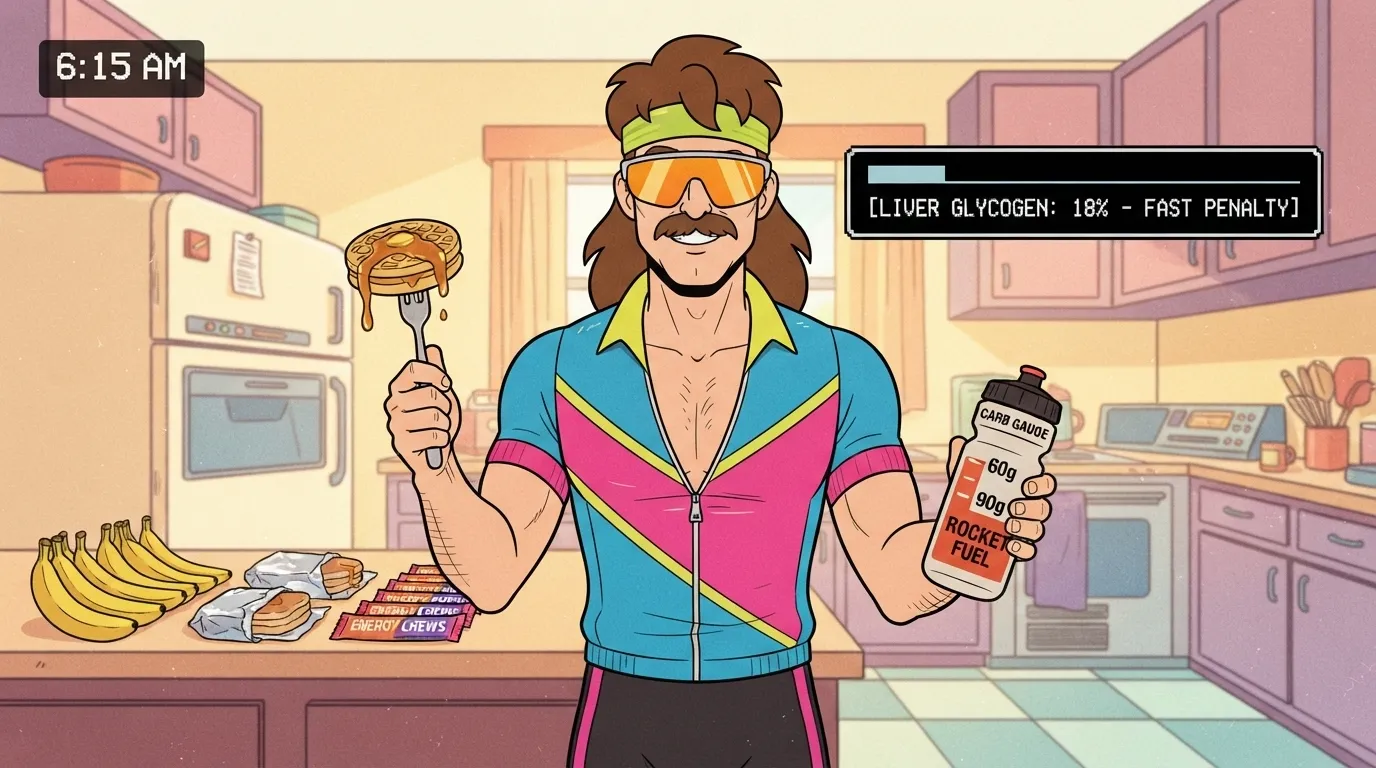
You probably did the damage before you clipped in. An overnight fast drains a big share of the sugar your liver keeps on hand, and then you grab a coffee and half a banana because the group rolls at seven. The first ninety minutes feel fantastic, because your muscles are still running on their own stores and don’t care about breakfast yet. Then the bill arrives on the long drag after the cafe stop, and nothing in your jersey pocket can pay it fast enough. Reaching for a gel at hour three is not fueling. It’s a rescue, and rescues are expensive.
Why do I bonk on long rides
Your body keeps carbohydrate in two places. A trained rider’s muscles hold somewhere around 400 to 500 grams. The liver holds about 100, and its job is to keep your blood sugar steady so your brain stays online. Your muscles can’t share their stash with your bloodstream. The liver can, and it does that all night while you sleep. By morning it can be down by roughly half.
So you start a four-hour ride with full legs and a half-empty tank guarding your brain. That’s why the bonk feels so strange when it hits. Your legs go hollow, sure, but so does everything else. The road looks grey. Your buddy’s joke makes you want to ride into a ditch. Power falls off a cliff, and heart rate often sags with it because you physically can’t push hard enough to raise it. If your heart rate was climbing at steady watts before you faded, that’s a different animal, usually heat and fluid loss driving the drift rather than an empty tank.
I learned this on camera. Episode four of Pedal to the Medal had me climbing a canyon road above Malibu on black coffee and confidence. Ninety minutes in I was a legend. Two and a half hours in I was sitting on a guardrail eating a stranger’s trail mix while the crew filmed the ocean to kill time. The mustache stayed upright. I did not.
What to eat before a long bike ride
The window that decides your ride is about twelve hours wide, and most of it happens at home.
Dinner the night before should be a normal meal that leans on carbs. Rice, potatoes, pasta, bread, whatever you actually like. You don’t need a pasta mountain. Proper carb loading is for big events and takes a couple of days, and a Saturday group ride doesn’t need it. You just want to go to bed topped up.
Breakfast matters more than people think. Two to three hours before a long ride, aim for roughly 1 to 2 grams of carbohydrate per kilo of body weight. For a 70 kilo rider that’s 70 to 140 grams, which looks like a big bowl of oatmeal with honey and a banana, or a bagel with jam and a glass of juice. Keep it low in fat and fiber, and keep it boring. Race morning is a bad time to discover that the fancy granola disagrees with you.
The early start is where most riders lose. Nobody cooks oatmeal at 5:40 a.m. on five hours of sleep, and I can see when you got five hours, so I’m guessing breakfast got smaller too. Put it out the night before. Overnight oats, a bagel on the counter, a bottle of juice in the fridge. If you only have 45 minutes before the ride, go smaller and simpler, mostly fast carbs, and start eating on the bike early.
How many carbs per hour cycling actually needs
For an easy ride under about ninety minutes, if you started well fed, you barely need anything beyond water. Past that, the numbers climb.
For two to three hours at endurance pace, 30 to 60 grams per hour does the job for most riders. For longer or harder days, 60 to 90 grams. Above about 60 you want a mix of glucose and fructose, because your gut absorbs each through a different door and glucose alone tops out around there. A typical gel carries 20 to 25 grams, so 90 an hour is a lot of eating, and it takes practice. Your gut trains like your legs do.
Timing is the bit that saves you. Start in the first 20 to 30 minutes, then eat on a schedule rather than waiting until you feel hungry. Hunger on a long ride is a late signal.
The rescue costs so much because of where it happens. At hour three you’re probably on a climb, working hard, and blood is going to your legs instead of your gut, so whatever you swallow arrives slowly. A gel takes something like 15 to 30 minutes to show up in your bloodstream. You spend those minutes riding on fumes, grinding out the kind of hurt that builds nothing, and your form falls apart. Then you pay again the next day, because a ride that drained you that far takes longer to come back from. One gel can’t refill what breakfast was supposed to supply. It just keeps you upright until the cafe.
What I can and can’t see in your ride file
I see a lot. I see the moment your power starts sliding at the two-and-a-half-hour mark, the heart rate sagging with it, the stop that ran twenty minutes long. I see how you slept and what your resting heart rate did the morning after. Put that next to a seven o’clock start and the story usually tells itself.
What I can’t see is your plate. Food doesn’t land in any file, and it bothers me that I’m usually reading your fueling backwards from a power curve after the damage is done. A fade in the third hour could mean an empty tank, a pacing mistake from the first hour, or a headwind on the way home, and the numbers alone won’t always separate those.
So I’ll ask. What did you eat, and when? Not to grade you. Over a few weeks, the answers show me things your file never will, like the fact that your best long rides all started with a real breakfast, or that every Sunday collapse follows a Saturday when dinner was a protein bar in the car.
The ride that leaves you on a guardrail eating somebody else’s trail mix almost never goes wrong out on the road. It goes wrong the night before, when you skip dinner, and again when the alarm goes off and you choose ten more minutes of sleep over a bowl of oats. Set the breakfast out before bed tonight. Hour three will be a lot kinder to you.